We use cookies to ensure our site functions properly and to store limited information about your usage. You may give or withdraw consent at any time. To find out more, read our privacy policy and cookie policy.
Manage Cookies
A cookie is information stored on your computer by a website you visit. Cookies often store your settings for a website, such as your preferred language or location. This allows the site to present you with information customized to fit your needs. As per the GDPR law, companies need to get your explicit approval to collect your data. Some of these cookies are ‘strictly necessary’ to provide the basic functions of the website and can not be turned off, while others if present, have the option of being turned off. Learn more about our Privacy and Cookie policies. These can be managed also from our cookie policy page.
Strictly necessary cookies(always on):
Necessary for enabling core functionality. The website cannot function properly without these cookies. This cannot be turned off. e.g. Sign in, Language
Analytics cookies:
Analytical cookies help us to analyse user behaviour, mainly to see if the users are able to find and act on things that they are looking for. They allow us to recognise and count the number of visitors and to see how visitors move around our website when they are using it. Tools used: Google Analytics
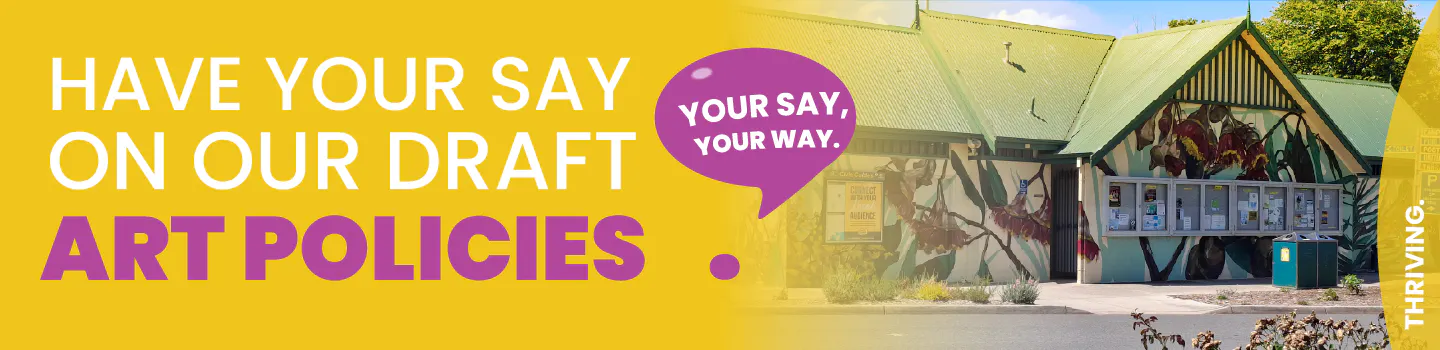
Shape our Public Art and Civic Art Collection Policies
We want to hear from you!
We’re reviewing our draft Public Art Policy and draft Civic Art Collection Policy before their planned adoption later this year, and we're keen to hear your thoughts.
These policies acknowledge the important role that art plays in our public spaces and civic settings, helping to turn locations around our Shire into quality spaces that our community wants to live, work and play in. They also protect the valuable assets of Council's Art Collections, covering how we will manage and maintain these collections over the next four years.
These draft policies were developed based on a community engagement workshop, benchmarking research, and arts sector knowledge and practices. Everyone in the Baw Baw Shire community is welcome to provide feedback on them by completing a survey or making a written submission by May 13th, 2026. This feedback will help to further shape the draft policies before they are brought to Council for adoption later this year.
The proposed key principles for Council's Art Collections include:
Diverse, inclusive and representative – It will reflect our community and its many ages, abilities and cultures, including those of First Nations peoples, and the Shire’s unique heritage and identity.
High-quality and curated - It will support and present creative, innovative works across a range of mediums that show strong artistic skill and cultural value to inspire and delight.
Supportive of the arts communities – It will strengthen the local arts communities through investment, visibility, and meaningful employment opportunities. Supporting local artists is a priority.
Accessible and engaging – It will be approachable, stimulating and supported by meaningful, plain English, interpretive signage. Access should be suitable for all ages and abilities and should also be available online where possible.
Educational and enriching - It will foster learning, cultural understanding, creativity, and meaningful engagement with the arts.
Purposeful and aligned – It will be developed with intent to enhance pride of place and align with Council’s broader strategic goals.
Public-facing – Displayed in appropriate spaces with easily accessible information about the artwork available online and on request.
Place-based and locally relevant — Public art will be informed by the site’s context, with sensitivity to the site's history, community, and culture.
Dynamic and evolving — Encourage long, medium and short term (including temporary, ephemeral and/or experiential) public art works and programs to encourage experimentation, play, and interactivity.
Sustainable and responsible — Public art will be environmentally and financially responsible, with clear planning for care, maintenance, and deaccession.
Here's how you can have your say:
Review the Draft Public Art Policy Document and Draft Civic Art Collection Policy Document and complete the survey to help shape the future of our region.
Alternately, please email arts@wgac.com.au with any questions or other feedback on these draft policies.
This community consultation closes at 5pm on Wednesday 13 May 2026.
We want to hear from you!
We’re reviewing our draft Public Art Policy and draft Civic Art Collection Policy before their planned adoption later this year, and we're keen to hear your thoughts.
These policies acknowledge the important role that art plays in our public spaces and civic settings, helping to turn locations around our Shire into quality spaces that our community wants to live, work and play in. They also protect the valuable assets of Council's Art Collections, covering how we will manage and maintain these collections over the next four years.
These draft policies were developed based on a community engagement workshop, benchmarking research, and arts sector knowledge and practices. Everyone in the Baw Baw Shire community is welcome to provide feedback on them by completing a survey or making a written submission by May 13th, 2026. This feedback will help to further shape the draft policies before they are brought to Council for adoption later this year.
The proposed key principles for Council's Art Collections include:
Diverse, inclusive and representative – It will reflect our community and its many ages, abilities and cultures, including those of First Nations peoples, and the Shire’s unique heritage and identity.
High-quality and curated - It will support and present creative, innovative works across a range of mediums that show strong artistic skill and cultural value to inspire and delight.
Supportive of the arts communities – It will strengthen the local arts communities through investment, visibility, and meaningful employment opportunities. Supporting local artists is a priority.
Accessible and engaging – It will be approachable, stimulating and supported by meaningful, plain English, interpretive signage. Access should be suitable for all ages and abilities and should also be available online where possible.
Educational and enriching - It will foster learning, cultural understanding, creativity, and meaningful engagement with the arts.
Purposeful and aligned – It will be developed with intent to enhance pride of place and align with Council’s broader strategic goals.
Public-facing – Displayed in appropriate spaces with easily accessible information about the artwork available online and on request.
Place-based and locally relevant — Public art will be informed by the site’s context, with sensitivity to the site's history, community, and culture.
Dynamic and evolving — Encourage long, medium and short term (including temporary, ephemeral and/or experiential) public art works and programs to encourage experimentation, play, and interactivity.
Sustainable and responsible — Public art will be environmentally and financially responsible, with clear planning for care, maintenance, and deaccession.
Here's how you can have your say:
Review the Draft Public Art Policy Document and Draft Civic Art Collection Policy Document and complete the survey to help shape the future of our region.
Alternately, please email arts@wgac.com.au with any questions or other feedback on these draft policies.
This community consultation closes at 5pm on Wednesday 13 May 2026.